A few months ago, a writer emailed us something that stuck:
"I got a 7.1. I don't know if I should be celebrating or panicking."
Fair question. And one worth answering properly, because a number without context is just a number. If you've ever uploaded a script to StoryChatPro and watched the evaluation come back, you've probably had a version of that same thought. So let's talk about what the score actually represents, how we think about evaluation, and most importantly, how to use it.
Why we score at all
We had long discussions about this internally. Scoring a creative work feels, on its face, a little absurd. A screenplay isn't a math test. One reader's 7.1 is another reader's 6.3. Development executives know this. Contest judges know this. Writers know it most of all.
But here's the thing: writers kept asking for it.
Not because they wanted a grade. Because they wanted a signal. A rough sense of where a draft stands. They want to know, is this a page-one rewrite situation, or am I in polish territory? Should I send this to my manager, or sit with it another month? When you're six drafts deep into your own pages, you lose perspective. A score, used correctly, is a way to borrow some back.
So we built one. But we built it with a lot of guardrails.
What the score is measuring
The short version: your score reflects how your script performs across the fundamentals that readers, assistants, and development executives actually evaluate when a script lands on their desk. Not whether it's "good." Not whether it will sell. Whether the core craft elements are working.
That includes things like:
- Whether your protagonist has a clear want and need, and whether those drive the story
- Whether your structure holds up under pressure, do act breaks land, do stakes escalate, does the midpoint do real work
- Whether your dialogue is doing more than one job at a time
- Whether your scenes have conflict, change, and consequence
- Whether your concept is clear enough that someone could pitch it back to you after reading
There are more dimensions than that, but you get the shape of it. We're looking at craft elements that are evaluable and not about taste, not commercial potential, not whether a specific producer will respond to it on a Tuesday.
What the score is not measuring
This is the part we want to be loud about.
The score is not predicting whether your script will sell. It's not predicting whether it will place in a contest. It's not telling you whether your voice is interesting, or whether your premise is fresh.
What the score can tell you is whether the foundation is sturdy enough to support everything else. A brilliant premise on a shaky structural foundation will still collapse when a reader hits page 40. The score catches structural collapse. It doesn't anoint brilliance.
Where Humans come in
We'll say this plainly: no evaluation tool, ours, or any others, replaces a thoughtful human reader who knows your work and the market you're writing into. What we can do is handle the diagnostic layer. The part that's draining to pay a reader for every draft. The part where you need to know, before you hand pages to someone whose time you value, whether the structure is holding.
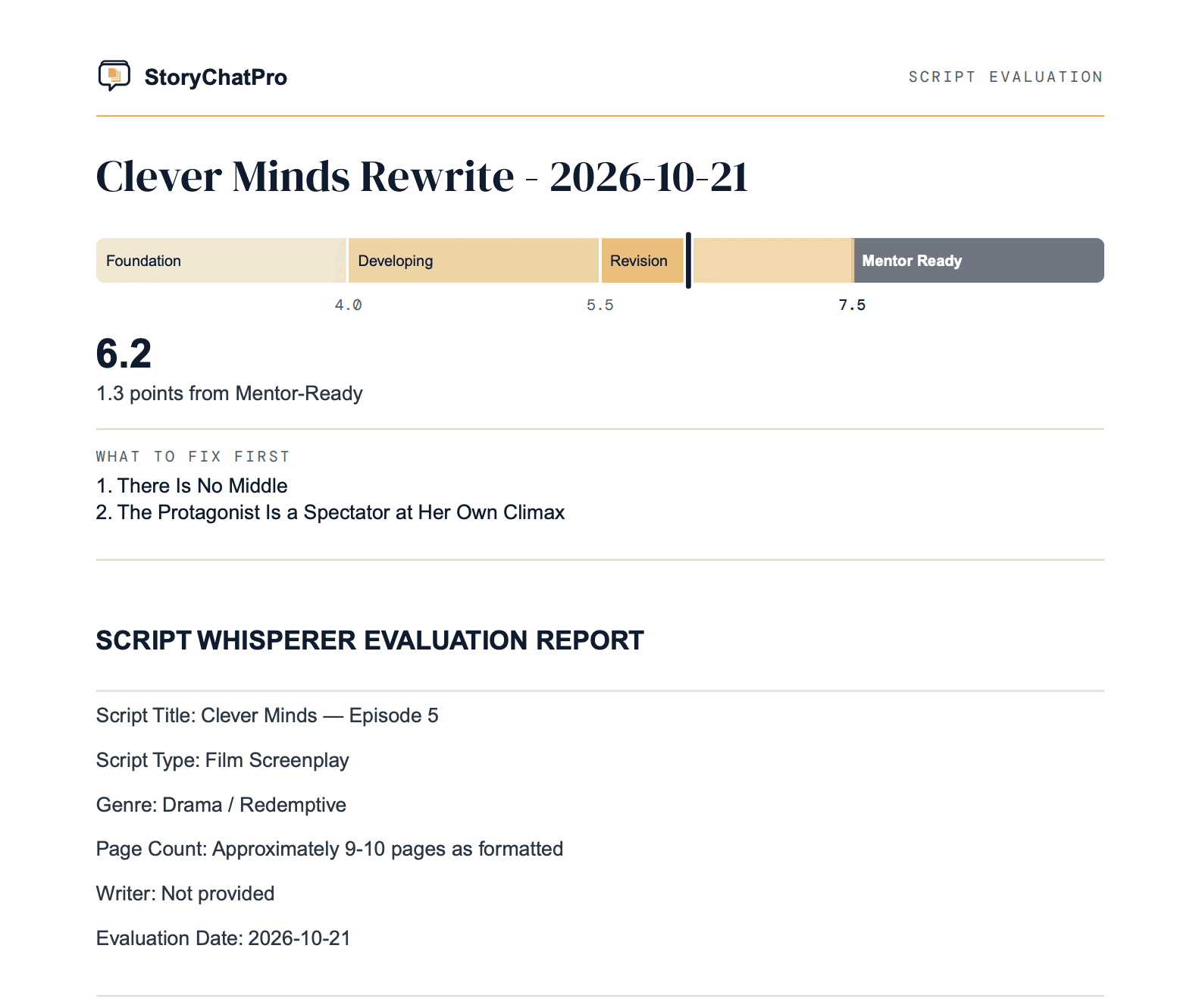
Once your score hits a 7.5 or higher (this does not mean a 75% out of 100%; it's not a 'C'). It means that the script has a strong foundation and is structure so you don't need to worry about spending good money to hear about structural problems in your script. You can use your time with your mentor to discuss what makes your characters, dialogue, story connect to audiences and where it can improve.
Why we refuse to be nice about it
One of the earliest decisions we made, and one we've never regretted, is that the feedback has to be honest. Which means sometimes it's uncomfortable.
We've all used tools that tell you your work is wonderful. The business strategy is to keep you coming back for that shot of dopamine. The praise feel good for about eleven seconds, and then they're useless. If every script scores an 92, the number means nothing. If every note starts with "This is such a strong draft," writers stop reading past the first sentence.
So our evaluation will tell you when a protagonist is passive. When a midpoint doesn't turn. When dialogue is on-the-nose. When your inciting incident arrives on page 22 and the reader has already drifted. It will do this politely, with specifics, and with suggestions but it will do it.
You will get compliments. They are backed up by what is working in the script, or a strength in a character. It's not fluff. It's honest feedback.
The writers who get the most out of StoryChatPro are the ones who want that. The ones who'd rather hear it from us than from a manager three months from now.
How to actually use your score
Here's the practical part. When you get your evaluation back, we'd suggest this order of operations:
1. Ignore the number for a minute. Seriously. Scroll past it. Read the notes first. The notes are where the information is. The score is a summary of the notes, not the other way around.
2. Look for patterns, not individual critiques. If three different sections of feedback mention your protagonist's agency, that's a pattern. One mention is a note. A pattern is a diagnosis.
3. Decide what you agree with. This is the part we can't do for you, and we wouldn't want to. You know your story. Some notes will land immediately. Some will feel wrong, and you'll argue with them in your head, and that argument will clarify what you actually meant to do. Both outcomes are useful.
4. Then look at the score — as a trend line, not a verdict. A 78 on draft three and an 84 on draft four tells you something real: the revision worked. A single score in isolation tells you less. We built the platform so you can run evaluations across drafts specifically for this reason.
The honest limits
The score isn't the point. The revision is the point. The score just tells you where to aim it.
So if you got an 7.1, like our writer did, here's the actual answer: you're probably not in page-one-rewrite territory, you're probably not ready to send it wide, and the notes will tell you which three or four things to focus on next. Celebrate for an evening. Panic never. Then open the document and get back to work.
That's what the tool is for.