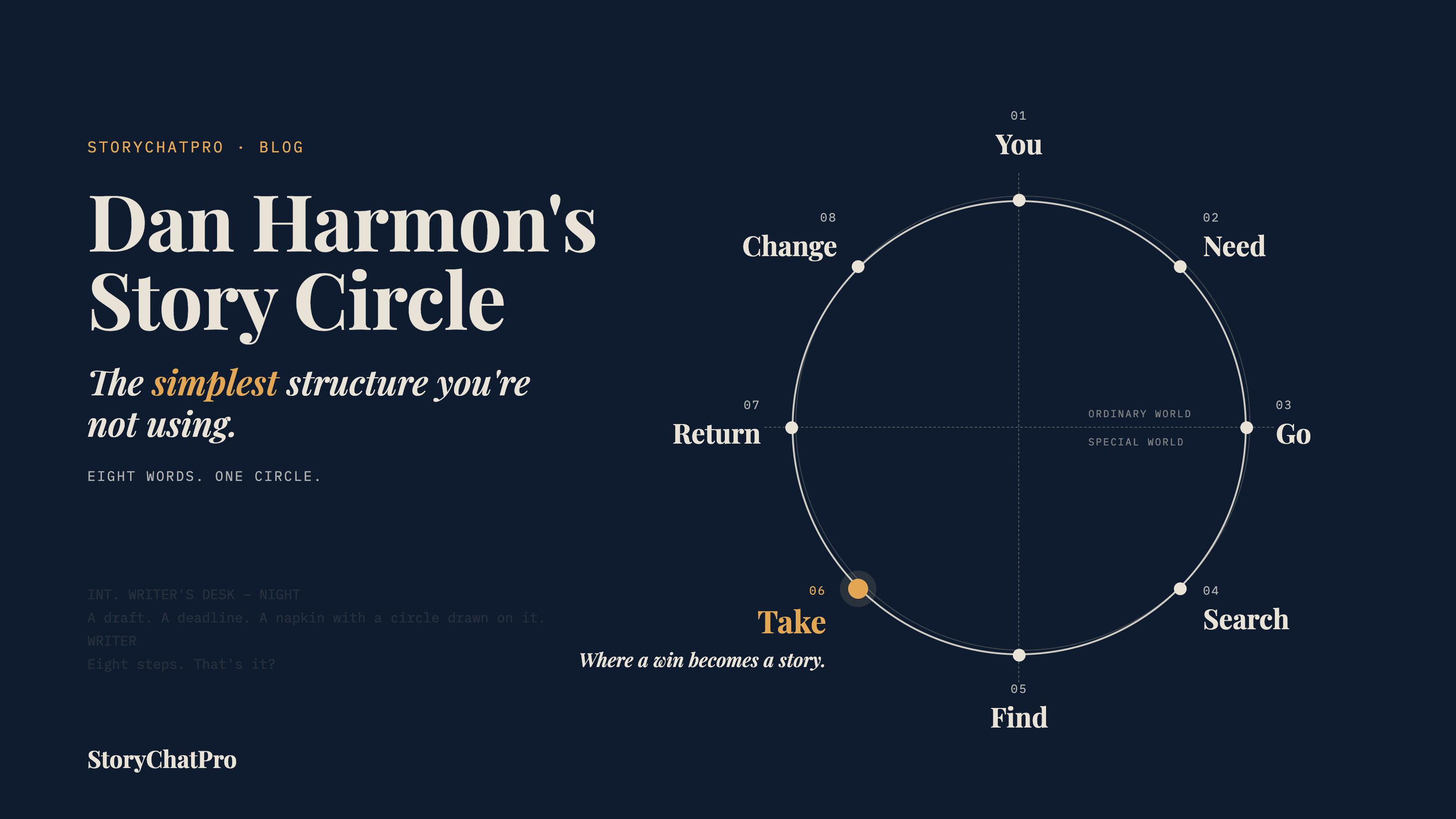
Dan Harmon, the creator of Community and co-creator of Rick and Morty, built much of his career on a structure he can draw on a napkin. Eight words. One circle. For more than a decade, Rick and Morty has used a cartoon scientist to remind audiences of the contradictions of being human, and Harmon has said the circle is one of the tools he uses to break the show's stories. Yet somehow most screenwriters I talk to have either never heard of it or dismissed it as "the Hero's Journey for people who don't want to read Campbell."
That's a mistake. The Story Circle isn't a shortcut. It's a diagnostic tool. And once you understand what it's actually measuring, it becomes almost impossible to write a scene that doesn't belong.
The Eight Steps
Here's the whole thing:
- You — A character is in a zone of comfort.
- Need — But they want something.
- Go — They enter an unfamiliar situation.
- Search — Adapt to it.
- Find — Get what they wanted.
- Take — Pay a heavy price for it.
- Return — Then return to their familiar situation.
- Change — Having changed.
That's it. You can memorize it in a minute. You'll spend the rest of your career trying to execute it well.
Why It's a Circle, Not a Line
Syd Field drew structure as a horizontal timeline. Three acts, two plot points, a midpoint. It's useful. It's also linear, and a straight line of milestones tends to make writers think of the beginning and end of a character's journey as completely unrelated things.
Harmon's circle does something different. It splits the story along two axes: an upper half (order, comfort, the known world) and a lower half (chaos, discomfort, the unknown). The protagonist descends from order into chaos, grabs what they came for, and climbs back out, permanently changed by the trip.
That vertical axis is the whole game. If your protagonist crosses from order into chaos but comes back the same person, you haven't written a story. You've written a vacation.
The Circle in Action: Finding Nemo
Let's run Pixar's most structurally perfect film through the circle.
- You — Marlin lives on the reef, overprotecting his only son.
- Need — He wants to keep Nemo safe. (The real need, which he doesn't know yet: he needs to let go.)
- Go — Nemo gets taken. Marlin leaves the reef.
- Search — He crosses the ocean, surviving a support group of troubled sharks, a forest of jellyfish, a ride with surfer sea turtles, and a fish with short-term memory loss who is somehow the healthiest relationship he's ever had.
- Find — He reaches Sydney. He finds Nemo.
- Take — He has to let Nemo swim into a fishing net to save Dory. The price is the exact thing Marlin spent the whole film refusing to pay: letting go.
- Return — Back to the reef.
- Change — Marlin now lets Nemo swim to school alone.
The circle doesn't just describe the plot. It reveals the theme. Step 6 (Take) is where the price of the external goal collides with the internal lesson. Marlin can't get Nemo back without surrendering the control he's been clutching since page one.
That collision is the thing most first drafts are missing.
The Trap of Step 5
Many early scripts stop at Find. The protagonist gets what they wanted, the credits roll, everyone goes home. It feels like a victory. It plays like an anticlimax.
Why? Because “getting what you want” is not a story unless you're changed by it. Harmon’s genius is making the Take step mandatory. You cannot leave the circle without paying for the thing you grabbed.
Take is where a win becomes a story. It’s the moment Find stops being a reward and starts having consequences.
Take doesn’t look the same in every story, though. In Finding Nemo, Take strips Marlin of his flaw, his need for control. He lets go, and comes home a better father. He earns what he found by becoming someone who can hold it.
There’s another kind of Take, a murkier one that reflects the darker side reality, where the bargain works like a deal with the devil. To get something, the character has to give up something they need: their conscience, the people they love, the person they used to be. And the story doesn’t always tell you whether the trade was worth it.
In The Godfather, though Michael wants to stay out of the family business, he sets out to protect his family and succeeds (Find). It costs him his soul. He orders his enemies killed while standing as godfather at his nephew’s baptism (Take). The circle closes as the door shuts on Kay: Michael has returned to the family, changed into the man he once said he would never be.
In Whiplash, Andrew gets his transcendent drum solo (Find). By then, he’s already lost his relationship, his body, his dignity and arguably his sanity (Take). The ambiguity of whether he’s won or lost is the whole point of that final shot.
Marlin’s Take makes him better. Michael’s makes him worse. Andrew’s leaves you to decide. Three very different Takes. None of these stories skips the step and none of the characters walks away unchanged.
Where This Beats the Three-Act for Diagnosis
I love three-act structure. I teach it. But when a writer brings me a script that 'feels off' and they can't figure out why, I almost always reach for the Story Circle, not the three-act.
Here's why: three-act structure tells you when things should happen. The Story Circle tells you why they should happen. If your Act Two feels mushy, the three-act model will tell you you need a midpoint. The Story Circle will ask you a sharper question: What is your protagonist searching for, and what are they adapting into?
That question kills bad scenes. If a scene in your middle doesn't involve your protagonist adapting to the unfamiliar world of the lower half, it's probably filler. Cut it or rewrite it until it does.
How to Use the Circle on Your Current Draft
Try this today. Open your script. Write the eight words down the side of a page. For each one, write a single sentence describing the scene or sequence in your script that fulfills that step.
If you can't fill in a step, that's your missing beat. If two steps map to the same scene, you've compressed something that needs room to breathe. If step 6 is weak or missing, that is, if your protagonist gets what they want without paying for it, you've just diagnosed why your ending doesn't land.
You've rewritten your opening fourteen times and haven't touched the Take step. I'm not judging. I'm just describing every writer I've ever met.
The Three Questions the Circle Forces You to Answer
At the top of the circle, your protagonist is one person. At the bottom, they find the thing they came for. By the time they return to the top, they must be someone different.
So here are the important questions, and I'd ask them before you write another word of your current draft:
Who is your protagonist at step 1? Who are they at step 8? Is the distance between those two people worth 110 pages of someone's life?
If the answer to that last question is yes, you have a story. If the answer is no, you have a plot. Harmon's circle doesn't care which one you've written. But it will tell you, with uncomfortable clarity, which one you have.